



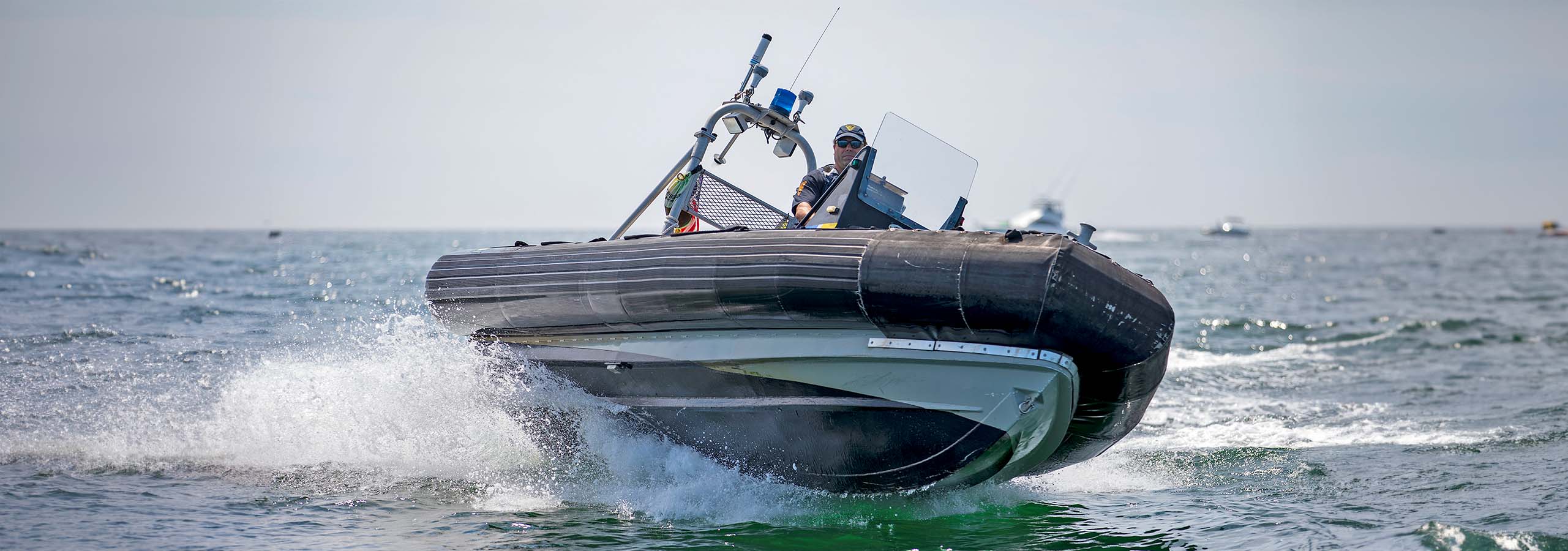
Baker 22' Zodiac Hullbanner
New Jersey State Police

MARINE SERVICE BUREAU FAQ's

A: The Marine Services Bureau determines whether requests for Slow Speed/No Wake Buoys are necessary. If a request is approved, the Marine Services Bureau will coordinate with the agency in charge of placing Slow Speed/No Wake Buoys. 

To make a request for a Slow Speed/No Wake Buoy, you must contact the Marine Services Bureau Station that is closest to the location of the requested Slow Speed/No Wake Buoy. To locate a Marine Services Bureau Station, please click HERE

A: Speed or No-wake is regulated by both, Title 12:7-45 Speed of Power Vessels and Title 13:82-1.7 Speed.

The rule states that the speed of a power vessel should be regulated to avoid injury or damage to property. Additionally, if you are within 200ft of any marina, pier, dock or wharf; work floats or barges engaged in work; through bridge openings less than 400ft wide; through waterways less than 200ft wide; vessels not under command; any vessel with flashing emergency lights activated. What does this mean? Within 200ft of any of the above listed conditions you are required to operate your vessel at minimum headway speed, regardless of the presence of a sign or buoy. If you are causing a wake, you are going too fast!


slow-no-wake

A: There are steps that one is required to take prior to using a vessel as their own. Follow the steps listed in the New Jersey Motor Vehicle Commission’s “Application for Title to an Abandoned Vessel” at: 

Application for Title to an Abandoned Vessel

https://www.nj.gov/mvc/vehicletopics/abandvessel.htm

A:

Contact the Marine Services Bureau to report the abandoned vessel.  A member of the Marine Services Bureau will conduct an investigation to locate the rightful owner and take appropriate enforcement action.  If the rightful owner is not responsive to removing his or her vessel the property owner may need to follow the steps listed in the New Jersey Motor Vehicle Commission’s “Application for Title to an Abandoned Vessel” at: NJ MVC | Abandoned Vessels  to acquire ownership of the vessel before disposing of it.

A: The right-of-way is determined by International and Inland Navigation Rules, as well as, New Jersey State Rules. A copy of the United States Coast Guard’s Navigation Rules and Regulations Handbook can be downloaded in PDF format at:

United States Coast Guard’s Navigation Rules and Regulations Handbook

https://www.navcen.uscg.gov/?pageName=navRuleChanges

New Jersey rules can be found by clicking on the following links: 

Also, see the below diagrams for more common meeting situations.

Rule 15: Crossing Situation

What is the appropriate action of each vessel operator?

  • In a crossing situation, the vessel which has the other on its starboard side shall keep out of the wayrule 15

Rule 14: Head-on Situation

What is the appropriate action of each vessel operator?

  • Each shall alter their course to starboard
  • When a vessel is in any doubt if the condition exists, assume the condition does exist and act accordingly

A: When a power vessel is making way and encounters a power vessel under way but not making way, drifting, all navigation rules and State rules apply. Vessels are responsible for their wake and any damage caused to the vessel being passed or injuries to its. (N.J.A.C. 13:82-1.7) Likewise, a vessel that is underway, but not making way, drifting, should not unreasonably interfere with another vessels or free and proper use of the waterway. (N.J.A.C. 13:82-1.10)

November 1 – May 1

New Regulation 13:82-1.4(f)

A: Federal law defines a recreational vessel as a vessel being manufactured or operated primarily for pleasure; or leased, rented, or chartered to another for the latter’s pleasure. 46 U.S.C. 2101.

A: All recreational vessels under 26 feet, including rowboats, canoes, kayaks, and stand-up paddleboards. In order to be exempt, the vessel must meet one of the listed exemptions of N.J.A.C. 13:82-1.4(d):

(1)  Vessels owned and operated by the United States;

(2)  Vessels owned or operated by the State of New Jersey or an agency thereof, a county, a municipality, a volunteer first aid, rescue or emergency squad, a search and rescue unit established within a fire district created pursuant to N.J.S.A. 40A:14–70 or a volunteer fire company created pursuant to N.J.S.A. 40A:14–70.1 when a child is on board as a direct result of being rescued from an emergency situation;

(3)  Commercial vessels, which are any vessel longer than 65 feet and operated for a purpose that requires a United States Coast Guard Operator’s License; and

(4)  Ferries, which are any vessels longer than 65 feet operating on a short run on a frequent schedule between two points offering a public service of a type normally attributed to a bridge or tunnel.

Application for Title to an Abandoned Vessel

https://www.state.nj.us/mvcbiz/Abandoned/Abandoned_vessels.htm

A: This regulation applies to all vessels except surfboards, racing shells, rowing sculls and racing kayaks

*Stand Up Paddleboards (SUP) – PFD’s are not required when operating SUP within the narrow limits of a swimming, surfing or bathing area.

A: A vessel that is not at anchor, or made fast to the shore, or aground.

So, the PFD must be worn when making way (during operation), or drifting. If you are anchored, or hunting or fishing up on a bank or in the marsh, it would not need to be worn.

A: The regulations will depend on what side of the state line your vessel is located. When you are boating in New Jersey water, you must follow New Jersey Laws and regulations.

A: The PFD should be USCG approved, the proper size for the wearer, and in good serviceable condition. If they are USCG approved, it will be stamped on or inside the PFD.

A: If your vessel is 26’ or longer you are not required to wear your US Coast Guard approved PFD. You are however, still required to have at least one US Coast Guard approved PFD per person on the vessel and accessible. If any occupant of the vessel is 12 years of age or younger, they are still required to wear a properly fitted USCG approved PFD, while underway, outside the cabin of the vessel.

A: Inflatable PFD’s are acceptable as long as they are USCG approved, the proper size for the wearer, and in good serviceable condition.

A: The length of your vessel should be what is stated on the registration card. The length should be from the tip of the bow in a straight line to the stern of the vessel. Bowsprits, rudders, outboard motors, and motor brackets, handles and other fittings, attachments and extensions are not included in the measurement.

A: The goal of this regulatory update is to prevent hypothermia deaths, and to decrease the risks placed upon first responders, during winter search and rescue operations, on the waters of New Jersey. In almost every instance of a vessel related drowning, the victim was not wearing a life vest. In the event you do go into the water during the cold-water months, wearing a USCG approved PFD allows for increased potential for rescue and survival, and worst-case scenario at least a recovery. The repercussions for not wearing a PFD during the cold-water months can potentially be fatal should an accident, mishap, or sudden weather event occur.

UCR Current Crime Data Acknowledgement

The following data has been submitted to the New Jersey State Police Uniform Crime Reporting Unit.

The reporting agency is solely responsible for the accuracy of the data. Any questions concerning the published data please refer to the submitting agency.

Under the Current Month Column, zeros signify that an agency reported no offenses OR that an agency is delinquent in reporting their data.

If no crime was reported in a particular category in the previous and current year then that category will not be displayed.

The reported data is preliminary and may or may not include ancillary contributing agencies, such as; State Police, New Jersey Transit Police, Park Police and Port Authority Police.

Year end data may be subject to review and verification prior to final publication.

Please note that UCR data is compiled to meet federal reporting specifications and in accordance with N.J.S.A. 52:17 B-5. The UCR data may not be comparable to other statistics compiled using different specifications. For more information regarding UCR data, please refer to the following link Crime/Law Enforcement Stats (UCR Program) — FBI